
If opening your closet feels more chaotic than calming, you’re not alone. A cluttered space doesn’t just look messy — it adds stress to your mornings, wastes valuable time, and makes getting dressed feel like a chore. This guide delivers a complete, step-by-step system to transform any overstuffed closet into a streamlined, functional retreat. You’ll learn practical strategies, smart closet storage hacks, and design-backed organization principles that create lasting order — not just a temporary tidy-up. If you’re searching for real-world techniques to achieve a perfectly organized closet for good, this blueprint will show you exactly how to get there.
Step 1: The Foundational Edit – How to Declutter with Purpose
Decluttering gets a bad reputation. People treat it like a breakup montage—dramatic, painful, full of regret. I disagree. Decluttering is curation. It’s choosing what earns space in your life. When you shift from “I’m losing things” to “I’m refining my style,” everything changes.
The Four-Box Method
I’m a big fan of structure, so I swear by the Four-Box Method:
- Keep – You wear it, love it, and it fits your current lifestyle.
- Donate/Sell – Great condition, but no longer you.
- Repair – Worth fixing (be honest here).
- Discard – Stained, torn, or beyond saving.
If you wouldn’t spend money repairing it, it probably belongs in Discard. (Yes, even the “someday” jeans.)
Ask yourself:
- Have I worn this in the last 12 months?
- Does this fit my body and my real life?
- If I saw this in a store today, would I buy it?
If the answer is no, that’s clarity—not failure.
Sentimental items are tougher. I recommend a small, designated memory box stored outside prime closet space. Limit the size. When it’s full, something has to graduate out.
And once you’ve edited down, smart closet storage hacks make maintaining order effortless. Pro tip: empty space isn’t waste—it’s breathing room.
Step 2: Strategic Sorting – Categorize for Ultimate Efficiency
Most people stop at “shirts with shirts.” That’s a start—but it’s not strategy. If your closet still feels chaotic, it’s because broad grouping alone doesn’t eliminate friction. Micro-categorization (breaking large groups into smaller, purpose-driven sections) is where the magic happens.
Group by Type—Then by Function
Start wide:
- Pants
- Tops
- Dresses
Then refine. Separate work blouses from casual tees. Split workout tops from weekend wear. That extra layer means you’re not digging through sequins when you need something boardroom-ready. (Your 8 a.m. self will thank you.)
Some argue this is overkill. But consider this: decision fatigue is real. Research from the American Psychological Association shows daily choices drain mental energy. The more streamlined your closet, the faster you move.
The Power of Color-Coding
Within each sub-category, arrange by color. Light to dark creates visual calm and makes gaps obvious. It’s retail logic—there’s a reason stores do this.
Prediction: As minimalism evolves, hyper-visual organization systems like this will likely become standard in modern homes.
Seasonal Rotation
Store off-season pieces in under-bed bins or high-shelf containers. Rotate quarterly.
Pro tip: Label bins by season and year.
These closet storage hacks don’t just save space—they future-proof your routine. And if you love efficiency indoors, try these kitchen organization ideas that save time and space next.
Step 3: The Right Tools – Elevating Your Closet with Smart Storage
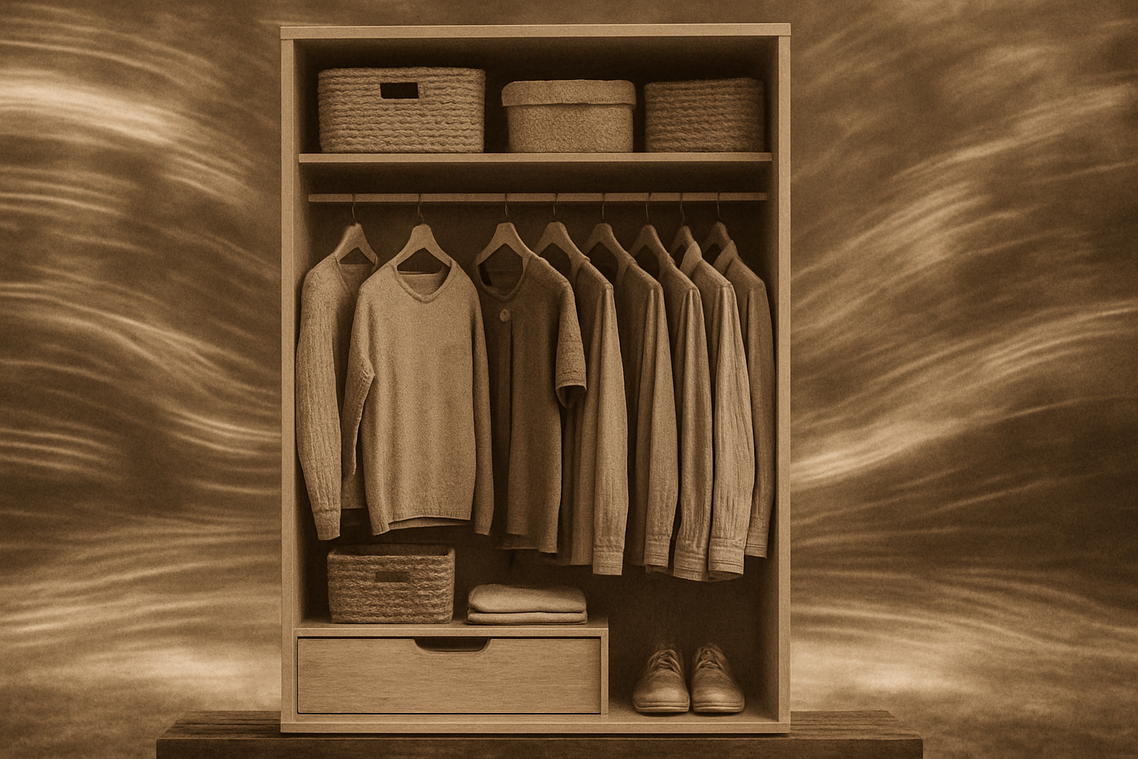
First things first: upgrade your hangers. If you change nothing else, switch to one single style of slim, non-slip hangers. This small shift creates visual calm and instantly makes your closet feel like a curated boutique (yes, the kind where everything looks expensive). Slim hangers also save horizontal space—studies show uniform slim hangers can increase hanging capacity by up to 30% compared to bulky plastic ones (National Association of Productivity & Organizing Professionals). My recommendation? Choose black velvet or natural wood and commit.
Next, look up. Vertical space is your best friend. Shelf dividers keep sweater stacks upright instead of toppling like a game of Jenga. Stackable bins multiply storage without adding clutter. Hanging organizers are ideal for shoes or folded denim. In other words, stop thinking in square feet—start thinking in cubic feet.
Then, tackle drawers. Instead of stacking clothes, try file-folding (popularized by Marie Kondo). File-folding means storing items upright so you can see every piece at once. It reduces forgotten items and unnecessary rebuys (we’ve all bought the “same” black tee twice). Add drawer dividers for socks, underwear, and accessories to prevent chaos from creeping back.
Finally, choose containers strategically. Use clear bins for easily identifiable items like shoes. Opt for opaque fabric bins when you want a cleaner, uniform look for seasonal or less-used pieces. Pro tip: label the inside rim for subtle organization.
These closet storage hacks aren’t about perfection. They’re about making your space work smarter, not harder.
Step 4: Intelligent Placement – Designing Your Closet’s Layout
A beautifully edited wardrobe can still fail if the layout works against you. So let’s talk strategy.
Mapping Your “Prime Real Estate”
First, define your closet’s prime real estate—the eye-level to waist-level zone where items are easiest to see and reach. This is valuable space (think beachfront property, but for blazers). Reserve it for pieces you wear weekly: your go-to jeans, everyday work shirts, favorite jacket. According to professional organizing standards, frequently used items should live between 15 and 60 inches from the floor for optimal accessibility (National Association of Productivity & Organizing Professionals).
Some argue every item should be equally visible to “maximize choice.” In reality, too many visible options create decision fatigue—a phenomenon studied by psychologist Barry Schwartz. Strategic visibility reduces stress and keeps mornings efficient.
Creating Zones That Flow
Next, blueprint your zones. Workwear on one side, casual wear on the other. Occasionwear slightly higher or farther back. Shoes belong either on the floor in aligned rows or in a vertical hanging organizer to save square footage. Bags rest upright on a top shelf with dividers to maintain shape.
Most competitors stop there. Here’s the overlooked edge: leave a small buffer zone—about 10% open space—so your system can breathe. (Crowded closets collapse fast.) Pro tip: empty space is a maintenance tool, not wasted space.
Accessory Solutions That Elevate
Belts hang neatly on wall-mounted hooks. Scarves fold into clear acrylic bins. Ties drape on slim racks. Jewelry rests in divided valet trays to prevent tangling. These closet storage hacks reduce friction and preserve quality.
Finally, install an inexpensive LED strip light. Proper lighting eliminates forgotten items—and forgotten items create clutter. When you can see everything clearly, order becomes effortless.
For even more creative solutions to everyday challenges, check out our Wutawhacks Column that dives deep into innovative ideas for optimizing your space.
Living with Your New System: Simple Habits for Lasting Order
You wanted more than random tips—you wanted a complete system you could actually live with. Now you have one. By decluttering, categorizing, and using smart closet storage hacks, you’ve replaced chaos with calm and turned daily frustration into smooth, stress-free routines.
The key to making this last is simple: start using the “One In, One Out” rule today. For every new piece you bring in, one old piece goes out. That’s how you protect your space from clutter creeping back in.
If you’re ready to enjoy a closet that stays organized year-round, commit to this habit now and take control of your space for good.
When closets begin to fill with off-season clothing, bulky accessories, or rarely used items, storage units Mississauga can help free up valuable space while keeping belongings accessible and organized.
 Home Care & Organization Advisor
Ask Dawnarina Conger how they got into clean lifestyle essentials and you'll probably get a longer answer than you expected. The short version: Dawnarina started doing it, got genuinely hooked, and at some point realized they had accumulated enough hard-won knowledge that it would be a waste not to share it. So they started writing.
What makes Dawnarina worth reading is that they skips the obvious stuff. Nobody needs another surface-level take on Clean Lifestyle Essentials, Modern Home Design Tips, Household Organization Hacks. What readers actually want is the nuance — the part that only becomes clear after you've made a few mistakes and figured out why. That's the territory Dawnarina operates in. The writing is direct, occasionally blunt, and always built around what's actually true rather than what sounds good in an article. They has little patience for filler, which means they's pieces tend to be denser with real information than the average post on the same subject.
Dawnarina doesn't write to impress anyone. They writes because they has things to say that they genuinely thinks people should hear. That motivation — basic as it sounds — produces something noticeably different from content written for clicks or word count. Readers pick up on it. The comments on Dawnarina's work tend to reflect that.
Home Care & Organization Advisor
Ask Dawnarina Conger how they got into clean lifestyle essentials and you'll probably get a longer answer than you expected. The short version: Dawnarina started doing it, got genuinely hooked, and at some point realized they had accumulated enough hard-won knowledge that it would be a waste not to share it. So they started writing.
What makes Dawnarina worth reading is that they skips the obvious stuff. Nobody needs another surface-level take on Clean Lifestyle Essentials, Modern Home Design Tips, Household Organization Hacks. What readers actually want is the nuance — the part that only becomes clear after you've made a few mistakes and figured out why. That's the territory Dawnarina operates in. The writing is direct, occasionally blunt, and always built around what's actually true rather than what sounds good in an article. They has little patience for filler, which means they's pieces tend to be denser with real information than the average post on the same subject.
Dawnarina doesn't write to impress anyone. They writes because they has things to say that they genuinely thinks people should hear. That motivation — basic as it sounds — produces something noticeably different from content written for clicks or word count. Readers pick up on it. The comments on Dawnarina's work tend to reflect that.